

Think you need to revise A-level biology and chemistry for the UCAT? You don’t. The test does not reward what you remember. It rewards how fast and how cleanly you reason with information placed in front of you.
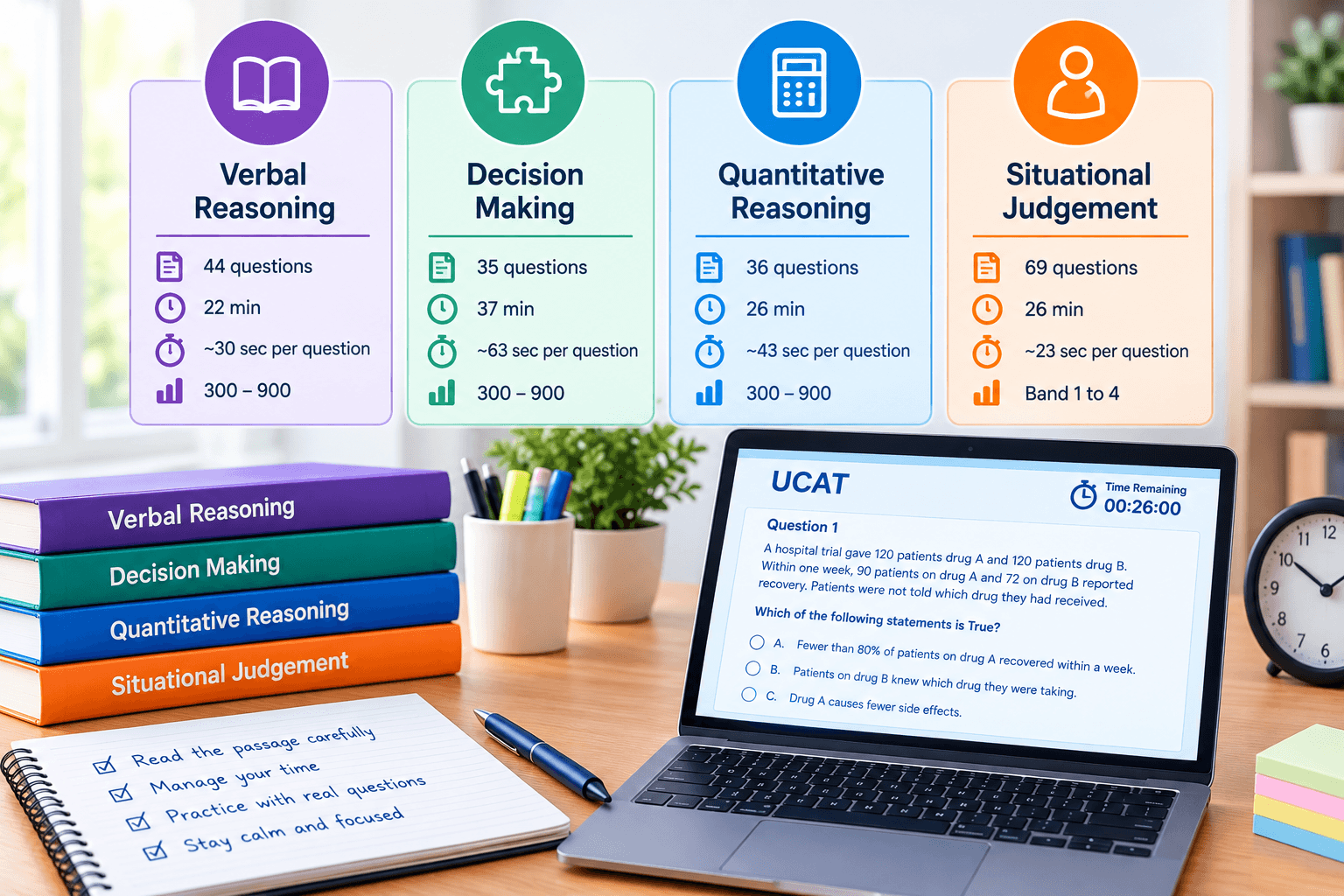
UCAT questions are multiple-choice items spread across four separately timed subtests: Verbal Reasoning (44 questions), Decision Making (35), Quantitative Reasoning (36) and Situational Judgement (69). That makes 184 questions in just under two hours, so most of the difficulty comes from the clock rather than the content.
The sections below cover what each question type looks like, how it is marked, and where candidates commonly lose marks.
The 184 questions at a glance
The structure changed recently, so check the date on any book or video you use. Abstract Reasoning was removed from the test in 2025, and Decision Making grew from 29 to 35 questions with a longer 37-minute window. Older guides that list five subtests are out of date.
| Subtest | Questions | Test time | Seconds per question (approx.) | Reported as |
|---|---|---|---|---|
| Verbal Reasoning | 44 | 22 min | 30 | 300 to 900 |
| Decision Making | 35 | 37 min | 63 | 300 to 900 |
| Quantitative Reasoning | 36 | 26 min | 43 | 300 to 900 |
| Situational Judgement | 69 | 26 min | 23 | Band 1 to 4 |
Each subtest also has a short instruction period (1.5 minutes, or 2 minutes for Quantitative Reasoning). The three cognitive subtests combine into a total between 900 and 2700. The full breakdown is on the official UCAT test format page.
The per-question times are only averages. Real UCAT questions vary enormously in difficulty, so some will take 15 seconds and others two minutes. The real skill is deciding quickly which is which.
Verbal reasoning: 44 questions, about 30 seconds each
Verbal Reasoning is built around short passages of text, typically with four questions per passage. Some questions ask you to judge a statement as True, False or Can’t Tell. Others are standard comprehension items with four answer options.
Historically this is where candidates score lowest. One tutoring provider reports a 2025 average of 602, the lowest of the cognitive sections. Treat that figure as indicative, since averages shift from year to year.
Here is a short practice-style passage I wrote to show the three outcomes:
“A hospital trial gave 120 patients drug A and 120 patients drug B. Within one week, 90 patients on drug A and 72 on drug B reported recovery. Patients were not told which drug they had received.”
- “Fewer than 80% of patients on drug A recovered within a week.” True. 90 of 120 is 75%.
- “Patients on drug B knew which drug they were taking.” False. The passage says patients were not told.
- “Drug A causes fewer side effects.” Can’t Tell. The passage says nothing about side effects. Verbal Reasoning practice questions
The third statement is where candidates slip. Real-world knowledge can feel helpful, but the passage is the only evidence allowed. If the text does not settle it, the answer is Can’t Tell.
Whether to read the passage first or the questions first depends on the person. Some candidates find keywords in the questions and then scan for them. Others do better reading the passage once, quickly. Test both over several timed sets and keep whichever gives you the higher score. ucat questions
Decision making: fewer questions, more marks
UCAT questions in this subtest are mini-puzzles, and Decision Making is the most varied section. The usual formats are syllogisms, logical puzzles, interpreting information, recognising assumptions, Venn diagrams and probability reasoning.
The marking is unusual. Single-answer questions are worth 1 mark, multiple-statement questions are worth 2 marks, and a partially correct response to a multiple-statement question earns 1 mark. The consortium page does not spell out the exact threshold for partial credit, so do not rely on a rule such as “four out of five.” One tutoring provider reports that 55 of 155 scored Decision Making questions across five 2025 test forms were drag-and-drop, roughly 11 per sitting. That means the section carries more raw marks than its question count suggests, and the multi-statement items deserve proper time. ucat questions
Try this syllogism: “All nurses on ward 4 have completed the training. Some people who completed the training are volunteers.” Does it follow that some nurses on ward 4 are volunteers? No. The volunteers who trained might all work elsewhere. “Definitely follows” means just that. Plausible does not count.
For scale, the UK average for this subtest was 620 in 2024, and the figures for the following year show 628. Venn diagram and probability questions are usually the quickest to improve with practice, because the method is learnable. Draw the diagram on your notepad every time, even when you think you can see the answer.
Quantitative reasoning: the calculator is slower than you think
You get an on-screen calculator, which tempts many candidates to use it for everything. It is slow. Quantitative UCAT questions usually test percentages, ratios, unit conversion and reading tables or graphs, and a rough estimate often rules out three of four options before you touch the calculator. ucat questions
Here is a practice-style example: a pharmacy sells paracetamol as 16 tablets for £1.60 or 32 tablets for £2.72. How much cheaper per tablet is the larger pack, as a percentage?
- Small pack: 10p per tablet. Large pack: 8.5p per tablet.
- Saving: 1.5p out of 10p, which is 15%.
Wrong options in questions like this are usually built from predictable errors, such as quoting the £0.48 saving instead of the percentage. Always check what unit the question asks for before choosing. UCAT maths practice questions
There are about 43 seconds per question, but time is rarely spread evenly. Multi-step data questions can take well over a minute, so quick arithmetic questions need to be done in 20 seconds to pay for them. If your centre or practice platform allows number-pad entry, check the official tutorial, because it can save time. ucat questions
Situational judgement: no answer to calculate
This subtest presents short scenarios from healthcare settings and asks you to rate how appropriate a response is, or how important a consideration is. There are 69 questions in 26 minutes, so you have only about 23 seconds each.
Results are banded rather than scored out of 900. Bands run from 1 (best) to 4. Policies vary by university, but some medical schools weigh the band heavily or may reject Band 4 applicants outright, so read each course’s admissions page carefully before you apply. official UCAT test format
Take this scenario: a fellow student tells you she has been photographing patient notes to study at home. Telling her directly that this breaches confidentiality and asking her to delete the images is likely to be rated appropriate. Reporting her to the dean without speaking to her first is likely to be rated less appropriate, because a proportionate first step exists. Ignoring it is likely to be rated very inappropriate. ucat questions
The common thread is proportionality, honesty, patient safety and working within your role. Candidates often lose marks by picking heroic solo actions, or by overlooking that a supervisor should be told when a risk is genuine.
Why the questions feel harder than the content
The mathematics and reasoning in these questions are not advanced. The difficulty is a combination of time pressure, unfamiliar formats and fatigue by the final subtest. Three structural points matter in practice:
- The test cannot be paused, and you cannot return to a subtest once it ends. Within a subtest, you can flag and revisit questions before its timer runs out.
- The UCAT is marked on correct answers, with no negative marking. A guess costs nothing, and a blank can never score.
- A candidate’s performance on one question does not change which questions follow. Nothing adapts to you, so one bad question should not change your approach to the next. ucat questions
For practice material, begin with the free official tutorials and question banks on ucat.ac.uk. Third-party question banks differ in difficulty and style, and a score from one provider does not transfer neatly to the real test. Use them for volume, but trust the official material for what actual UCAT questions look like.
Common questions from candidates
Are wrong answers penalised?
No. The UCAT is marked on correct answers only, so a wrong answer costs nothing beyond the missed mark. Answer every question, even when guessing. Before time runs out in each subtest, fill any blanks with a guess, because unanswered questions can never score.
Can I go back to earlier questions?
Within a subtest you can flag questions and return to them before the timer ends. Once a subtest finishes, you cannot return to it, and the whole test cannot be paused. Give every question an answer before moving on, then use leftover time on flagged ones.
Which subtest is hardest?
It depends on your strengths. Verbal Reasoning has historically produced the lowest average, about 602 in 2025 according to one tutoring provider, while Decision Making averaged 628 that year. Practise all four, but expect the effort-to-gain ratio to differ from one candidate to the next.
Do I need A-level science for the test?
No. UCAT questions draw on information supplied inside the question, plus basic arithmetic and everyday reasoning. You are not tested on A-level content. Careful reading, strict logic and comfort with percentages, ratios and unit conversion cover nearly everything.
Will the format be the same next year?
The 2026 cycle used four subtests after Abstract Reasoning was dropped in 2025. The consortium can change the format, so check the test format page on ucat.ac.uk before you register for 2027. Older books and videos sometimes still show five subtests.
One habit that changes how you practise
Most candidates review wrong answers by reading the explanation and moving on. That feels productive and teaches little. ucat questions
Try this instead. For every question you miss, write down two things: the exact sentence, number or rule that decided the answer, and one cause tag from a short list such as misread, maths slip, ran out of time, wrong assumption, or poor judgement call.
After about 50 misses, count the tags. In many cases one cause dominates, though yours may not follow that pattern. If “misread” accounts for most of your errors, more timed sets will not help. Slowing down on the final line of each statement will.
Pair this with a skip trigger for each subtest, based on roughly 1.5 times the average time per question. As a starting point, that is about 45 seconds in Verbal Reasoning, 95 seconds in Decision Making and 65 seconds in Quantitative Reasoning. When the trigger hits, guess, flag and move on. Adjust the numbers once your log shows where you actually lose time. ucat questions
