

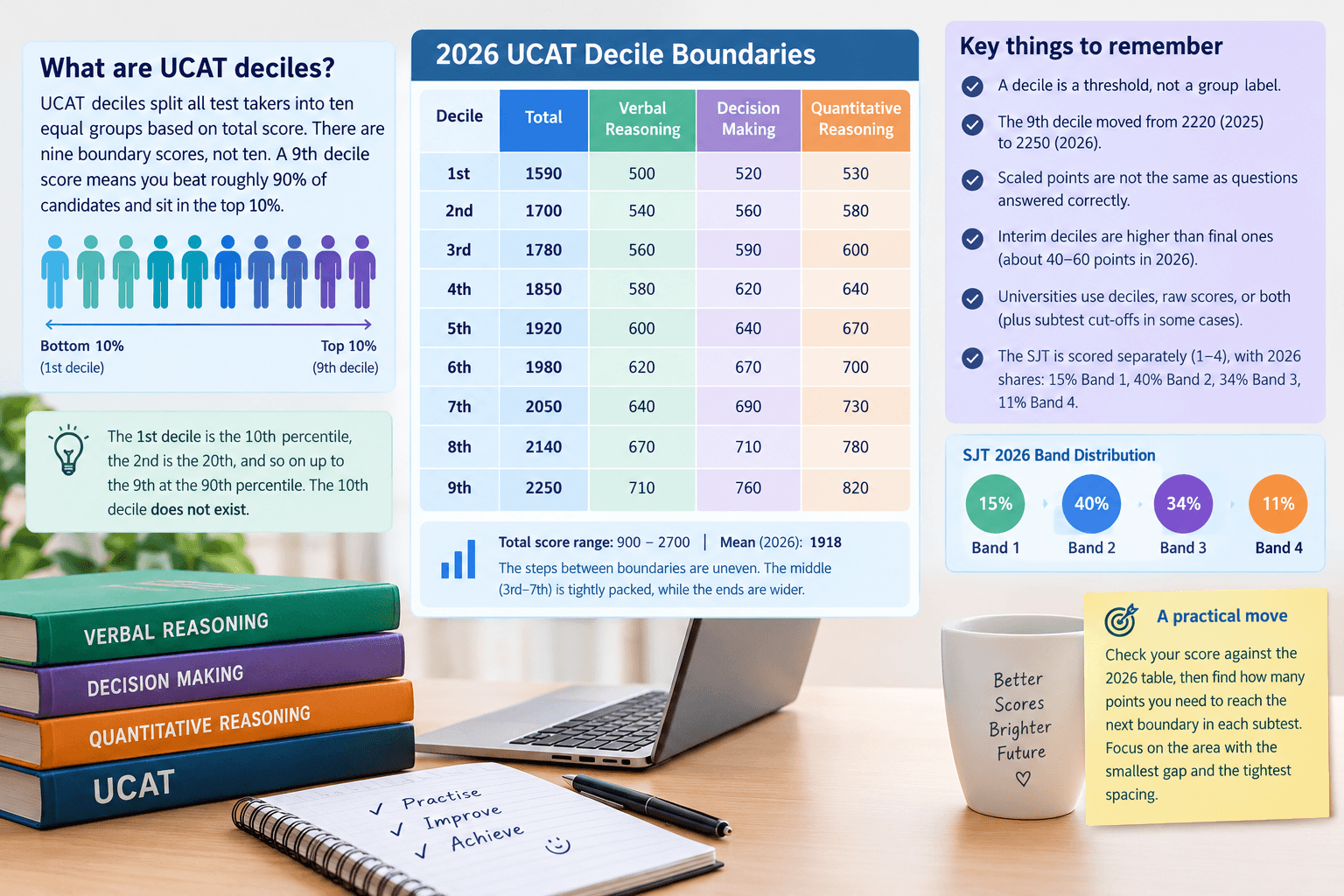
Seeing “9th decile” and assuming it means the top 9% is the most common misreading of UCAT results. UCAT deciles split everyone who sat the test into ten equal groups by total score. The 9th decile boundary in 2026 was 2250, so a score at or above it beat roughly 90% of candidates and sits in the top 10%. The figures below come from the UCAT Consortium’s final 2026 statistics, based on 42,359 tests taken up to 24 September 2026.
There are nine boundaries, not ten
A decile figure is a threshold, not a group label. The 1st decile is the score at the 10th percentile, the 2nd is the score at the 20th percentile, and so on up to the 9th at the 90th percentile. Nine thresholds create ten groups, which is why nobody can quote a “10th decile score”. People simply say “top decile” for anything above 2250.
The total is the sum of three cognitive subtests, each scaled from 300 to 900, so the possible range is 900 to 2700. The 2026 mean was 1918. Abstract Reasoning was removed in 2025, which means results from earlier years sit on a different four-subtest scale. A 2023 decile and a 2026 decile are not directly comparable, and pages that line them up in one table without a warning are mixing two different measures.
The Situational Judgement Test is scored separately. It produces a band from 1 (best) to 4, not a decile. ucat deciles
The full 2026 table
Here are the final 2026 boundaries for the total score and for each subtest.
| Decile | Total | Verbal Reasoning | Decision Making | Quantitative Reasoning |
|---|---|---|---|---|
| 1st | 1590 | 500 | 520 | 530 |
| 2nd | 1700 | 540 | 560 | 580 |
| 3rd | 1780 | 560 | 590 | 600 |
| 4th | 1850 | 580 | 620 | 640 |
| 5th | 1920 | 600 | 640 | 670 |
| 6th | 1980 | 620 | 670 | 700 |
| 7th | 2050 | 640 | 690 | 730 |
| 8th | 2140 | 670 | 710 | 780 |
| 9th | 2250 | 710 | 760 | 820 |
The steps between boundaries are uneven. Going up the total column, the gaps are 110, 80, 70, 70, 60, 70, 90 and 110 points. The middle of the field is tightly packed, with about 60 to 70 points separating each decile from 3rd to 7th. Both ends are stretched: climbing from the 8th to the 9th boundary costs 110 points, the same as the jump from the 1st to the 2nd. ucat deciles
For context, the 9th decile moved from 2220 in 2025 to 2250 in 2026. The 8th rose from 2100 to 2140. Nothing dramatic, but a score that was comfortably “top 20%” last year can sit closer to the line this year.
The same score means different things in each subtest
This is the detail most guides skip, and it changes how you should read a score report. Look at the 700 row across subtests. ucat deciles
A Verbal Reasoning score of 700 sits between the 8th and 9th decile boundaries (670 and 710). A Decision Making 700 sits just under the 8th (710). A Quantitative Reasoning 700 is only the 6th decile boundary.
So a candidate with 700 in all three subtests totals 2100. That lands between the 7th (2050) and 8th (2140) boundaries. Their Verbal result is outstanding, their Quantitative result is merely above average, and the total hides that. The subtest means tell the same story: 602 for Verbal Reasoning, 640 for Decision Making and 675 for Quantitative Reasoning. Quantitative scores run higher across the whole cohort, so a number that feels weak in one section can be strong in another. ucat deciles
This matters for universities that look at individual subtests or set subtest cut-offs, which the UCAT Questions Consortium confirms some do.
Interim deciles are a ceiling, not a forecast
Every September, preliminary statistics appear before testing closes. They are tempting to use, but early testers are not a typical group, and the gap between interim and final figures is large and consistent.
In 2026, the interim mean from the first batch of tests (to 13 September) was 1970. The final mean was 1918, a drop of 52 points. The same thing happened in 2025, when a preliminary mean of 1939 settled at 1891. ucat deciles
The decile boundaries moved the same way. The interim 2026 deciles ran from 1630 to 2300. The final ones run from 1590 to 2250, which means every boundary fell by between 40 and 60 points.
The practical consequence is that if you benchmarked yourself against interim figures, you are probably ranked slightly higher than you thought. If you are planning ahead, use final tables from the previous year rather than the first numbers released in a cycle. ucat deciles
What universities actually do with a decile
A decile is a communication tool. Universities mostly care about your score, and they do not all use it the same way. According to the UCAT Consortium’s page on how UK universities use the UCAT, some set a fixed threshold you must reach, some set a threshold each year after seeing applicants, and others weight the score alongside academic factors such as GCSE results. Most look at the total, but some look at subtests and even apply subtest cut-offs.
Two examples show how varied this is. The University of Sunderland has said it selects candidates from the top 8 deciles of the cohort, which in effect excludes the bottom two groups. Keele has previously quoted a fixed cut-off of 1700. Check each medical school’s current page before relying on either, because these policies change between cycles. ucat deciles
There is also a subtle trap. Some universities generate their own percentiles from their own applicants. Medicine applicants are a self-selected group, so a candidate in the 5th decile of all test takers (1920) can sit well below the middle of a medical school’s applicant pool. Ranking-heavy universities have historically drawn their interview lines in the upper deciles. So the national decile tells you where you stand among everyone, not where you stand among the people you are competing against.
The SJT works differently again. In 2026, 15% of candidates received Band 1, 40% Band 2, 34% Band 3 and 11% Band 4. Those shares are outcomes, not fixed quotas, and they shift year to year. Some universities exclude Band 4 candidates, so a strong cognitive total does not make the SJT irrelevant. ucat deciles
Questions people ask
What are UCAT deciles?
They are the ten equal-sized groups of test takers created by ranking total scores. Nine boundary scores mark the divisions. In 2026 the 1st decile boundary was 1590 and the 9th was 2250. A score at or above 2250 is in the top 10% of that year’s candidates.
Is a 9th decile score the same every year?
No. Boundaries move with the cohort, and the scale itself changed in 2025 when Abstract Reasoning was removed. The 9th decile was 2220 in 2025 and 2250 in 2026. Compare yourself against the same year’s table, not an older one.
Do interim deciles ever match the final ones?
Not closely. In 2026 every interim boundary was 40 to 60 points higher than its final counterpart, because early testers scored above the full cohort. Treat interim figures as optimistic. Final statistics are published shortly after the testing window closes.
Do universities use deciles or raw scores?
Both, depending on the school. Some quote a fixed score threshold, some use bands of deciles such as “top 8”, and some generate percentiles from their own applicants. Read each university’s own selection page, since methods and cut-offs differ by course and can change annually.
Do subtests have their own deciles?
Yes. The UCAT Consortium publishes decile boundaries for Verbal Reasoning, Decision Making and Quantitative Reasoning. A subtest score of 700 is only the 6th decile in Quantitative Reasoning but sits near the 9th in Verbal Reasoning, so the same number carries different weight in each.
A practical move: audit your distance to the next boundary
Most candidates compare their total to the table once and stop. A more useful habit is to work out, subtest by subtest, how many scaled points separate you from the next decile boundary, then look at where that gap is cheapest to close. ucat deciles
The boundaries are not evenly spaced across subtests. In Verbal Reasoning, the 5th, 6th and 7th boundaries sit at 600, 620 and 640, only 20 points apart. In Quantitative Reasoning, the 6th, 7th and 8th sit at 700, 730 and 780, which is 30 and 50 points apart. In the middle of the field, a small Verbal gain therefore moves your rank further than the same gain in Quantitative Reasoning. The tight packing also works against you, since a small slip costs rank just as quickly.
Keep one caution in mind. Scaled points are not the same as questions answered correctly, and the conversion is not linear, so use this to decide where to spend practice time, not to predict a result. Take timed practice papers from the official UCAT Practice Questions site, note your scaled score per subtest, and measure the distance to the next boundary in the 2026 table. If you are weeks from a retake, whichever subtest has the smallest gap and the tightest boundary spacing is usually the better investment. ucat deciles
